
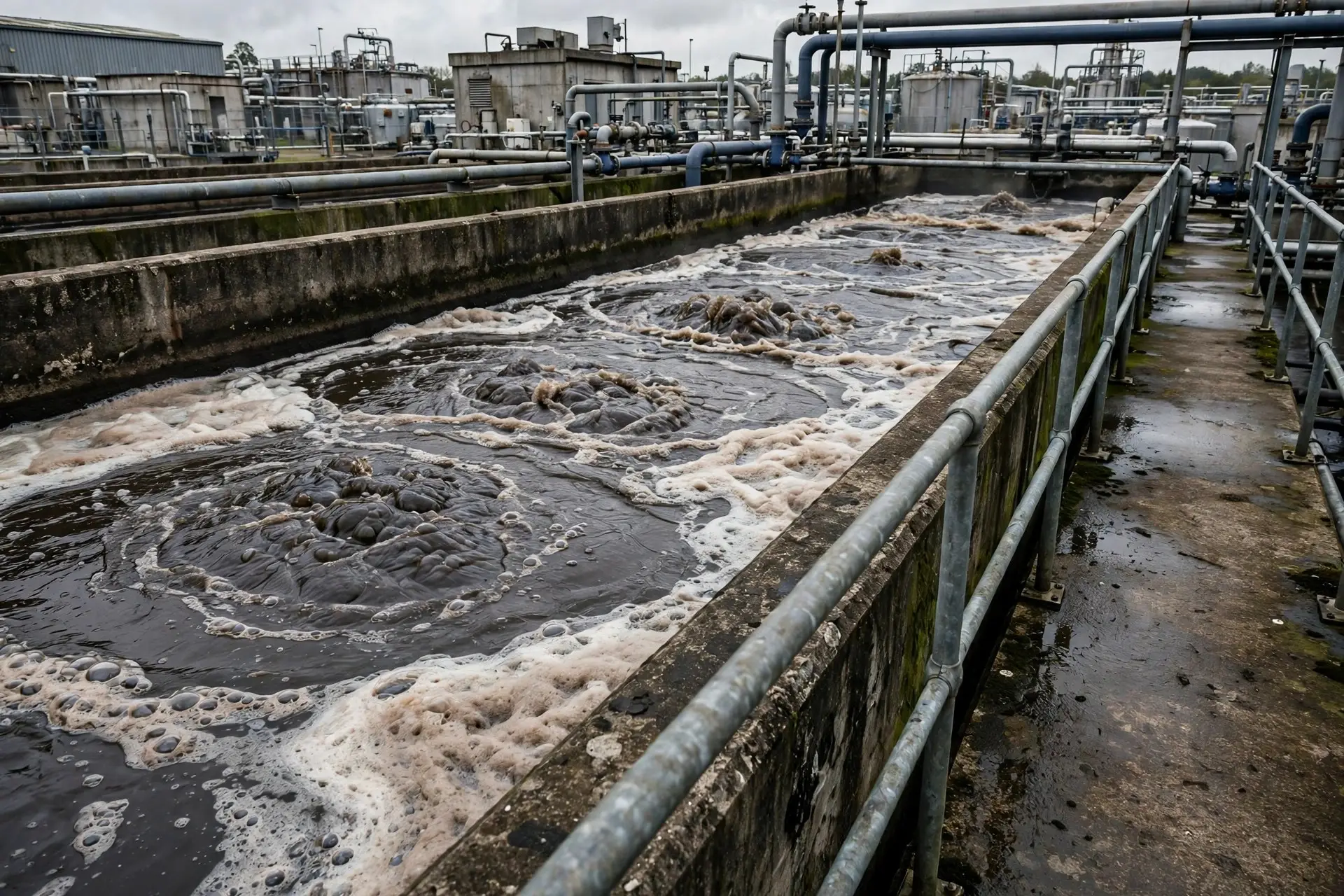
Realistic illustrative image: an industrial effluent aeration tank in operation.
An effluent plant is not a municipal sewage plant
An operator who has run both will tell you the difference in the first week. A municipal plant receives a flow that rises and falls with people and weather, but its character changes slowly. An effluent plant receives what a factory actually made that day: a strong washdown, a batch discharge, a cleaning chemical, a surge of oil and grease, or a load that is hot, acidic, or loaded with solids.
That is why diffused aeration and agitation matter in an effluent plant, and why they must be understood as two jobs, not one. Aeration supplies oxygen where biological treatment needs it. Agitation keeps the tank contents mixed, even, and in suspension. A tank can be well aerated in one corner and dead in another, or well mixed with too little oxygen for the load in front of it. Both failures show up downstream, as poor settlement, odour, a consent breach, or a downstream process that receives a shock it was never designed for.
What diffused aeration does, and what agitation adds
Diffused aeration introduces air through diffusers at or near the bottom of a tank. As bubbles rise, oxygen transfers into the liquid, and the rising bubbles also stir the tank. In a biological stage, that oxygen feeds the bacteria that break down organic matter, measured in practice as chemical oxygen demand and biochemical oxygen demand. In an equalization or holding tank, the same air can serve a different purpose, keeping the contents moving so solids do not settle, layers do not form, and the tank does not turn septic between discharges.
Agitation is the mixing job in its own right. It homogenizes a tank after a strong batch arrives, so downstream processes see a steadier load instead of a slug. It keeps solids in suspension, prevents dead zones behind baffles and in corners, and stops a tank turning septic between discharges, even when oxygen demand is low.
A specifying engineer should therefore state oxygen transfer and mixing separately, at normal and peak load and at minimum flow.
Why industrial effluent is harder on air systems
Industrial effluent brings problems municipal sewage rarely brings at the same intensity. Load can change by a large factor within a shift, temperature can reduce oxygen solubility, oil and grease can coat diffusers and create foam, solids and fibres can block fine pores, and pH swings and cleaning chemicals can attack materials. A brief toxic shock can upset biology that then takes days to recover.
None of this means diffused aeration is the wrong choice. It means the diffuser, blower, and control choices must be made for the actual effluent, not for a generic wastewater. A diffuser that performs well in clean municipal service can foul quickly in a greasy effluent. A blower sized for average municipal load can be overwhelmed by an industrial peak that arrives in an hour. A control system that assumes a smooth daily curve will chase its tail when production discharges in batches.
Design for variation from the start, with equalization that smooths flow and load before the biological stage sees them, and gives operations time to respond to a shock.
Fine bubble, coarse bubble, and the fouling question
Diffuser choice is where many effluent plants win or lose. Fine bubble diffusers produce small bubbles with a large surface area, and they usually transfer oxygen more efficiently in clean water. Coarse bubble diffusers produce larger bubbles, transfer oxygen less efficiently per unit of air, but mix more vigorously and are generally more tolerant of solids, grease, and fouling.
In an effluent plant, that tradeoff must be judged on site conditions, not on a clean water efficiency figure alone. If effluent carries grease, oil, fibres, or high solids, fine pores can clog, pressure rises, air distribution becomes uneven, and oxygen transfer falls, while diffuser cleaning becomes frequent and disruptive.
Material choice matters too. Diffuser membranes, housings, and piping must suit effluent chemistry, temperature, and cleaning, and grids must be isolable in sections so maintenance does not shut down the whole tank.
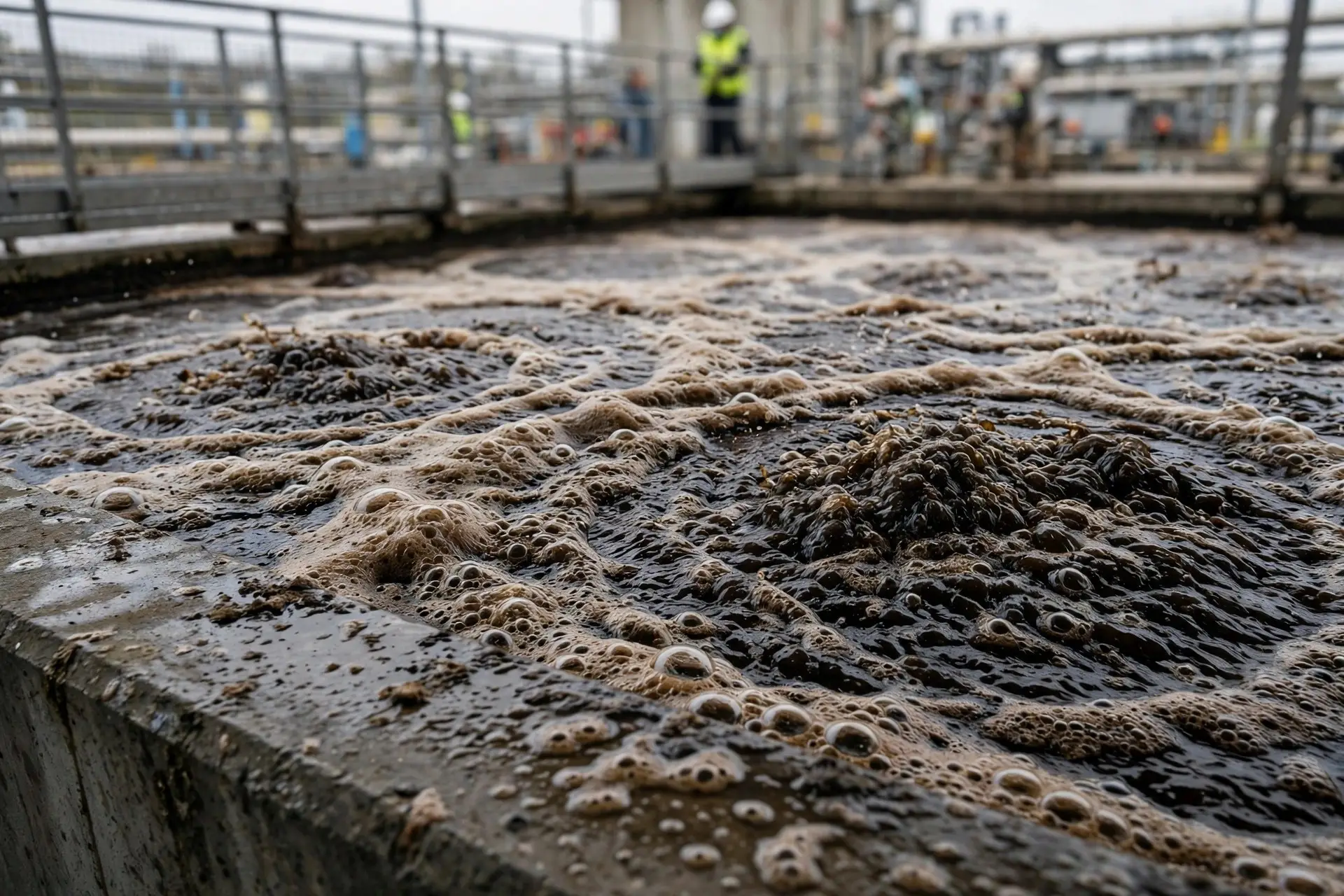
Realistic illustrative image: diffused aeration agitating industrial effluent at the tank surface.
Sizing for flow, load, and mixing, not just for air
Sizing starts with flow, load, and mixing, not just air. The engineer needs flow at normal, peak, and minimum, organic load at normal and peak, temperature range, tank dimensions and depth, mixing duty at each level, equalization volume, batch size, and production schedule, because those set the peaks the air system must actually handle.
Pressure, as in municipal aeration, is a stack of losses. The water depth sets the static head, roughly 0.43 pounds per square inch per foot of submergence, with diffuser, piping, valve, and filter losses on top, plus an allowance for fouling. An illustrative stack for about 12 feet of water depth:
| Pressure component | Illustrative value |
|---|---|
| Static head, 12 feet of water | About 5.2 psi |
| Diffuser loss | About 1.2 psi |
| Piping, valves, and fittings | About 0.8 psi |
| Inlet filter and miscellaneous | About 0.3 psi |
| Fouling and operating allowance | About 0.5 psi |
| Total at the blower discharge | About 8.0 psi |
That example is not a design for any specific plant. It shows why fouling and diffuser loss, often larger in industrial service, must be allowed for from the start. A total taken from clean diffuser data will be too low for a greasy or high solids effluent, and the blower will be short when the plant needs it most.
Check mixing separately too: tank volume, required turnover, and maximum dead zone, at minimum level as well as full level, where a shallow tank can leave solids settling just when a batch arrives.
Choosing the blower for a variable effluent load
Blower choice follows the same honest comparison as in municipal aeration, with industrial variability added.
A turbo blower is a single stage centrifugal machine built around a high speed permanent magnet synchronous motor. The impeller mounts directly on the motor shaft, an integrated inverter controls speed precisely against demand, and the shaft rides on bearings with no contact, air foil or magnetic levitation at the customer's preference, rather than oil lubricated rolling bearings. The package is compact and uses no oil, with a high-efficiency permanent magnet motor. A turbo blower can save energy relative to a comparable conventional blower at the same duty, by matching airflow to process demand instead of throttling or blowing off air; how large the saving is depends on the operating profile, the baseline equipment, and diffuser condition, and it is calculated per application. Turbo packages cover 106 to 17,600 cubic feet per minute at 4.2 to 14.2 psi, with shaft powers from 10 to 600 horsepower.
Positive displacement blowers remain right in many effluent duties, especially where pressure is higher, flow is lower, or pressure varies widely, and where a plant team values a familiar, robust machine for a harsh duty. They also suit duties where air must be delivered at a near constant volume despite pressure changes in a fouled diffuser grid.
In practice, turbo blowers deliver their best economics at higher flows, moderate pressures, and variable demand. Near the boundary, decide on measured power at minimum, normal, and peak, plus maintenance, footprint, and noise, and always check against fouled diffuser pressure, not just clean pressure.
Controls and daily operation
Controls in an effluent plant must handle batches, not just a smooth curve. Dissolved oxygen control, where it applies to a biological stage, should follow a dissolved oxygen signal rather than a fixed blower speed. In equalization and holding tanks, level and flow pacing, timers, and manual override matter just as much, because the job there is often mixing and homogenization, not oxygen control to a tight setpoint.
Air distribution balancing is a daily job, not a commissioning afterthought. Check valves to each grid so air is even across the tank, especially after cleaning or a level change, and watch early for rising pressure, uneven surface patterns, dead corners, excessive foam, or a septic smell despite air running.
Maintenance on a turbo package is essentially limited to replacing the inlet suction filter, with no lubricating oil to change and no belts or couplings to service. Diffuser inspection and cleaning remain separate, with frequency set by the effluent, and grids must be isolable without shutting down the whole tank.
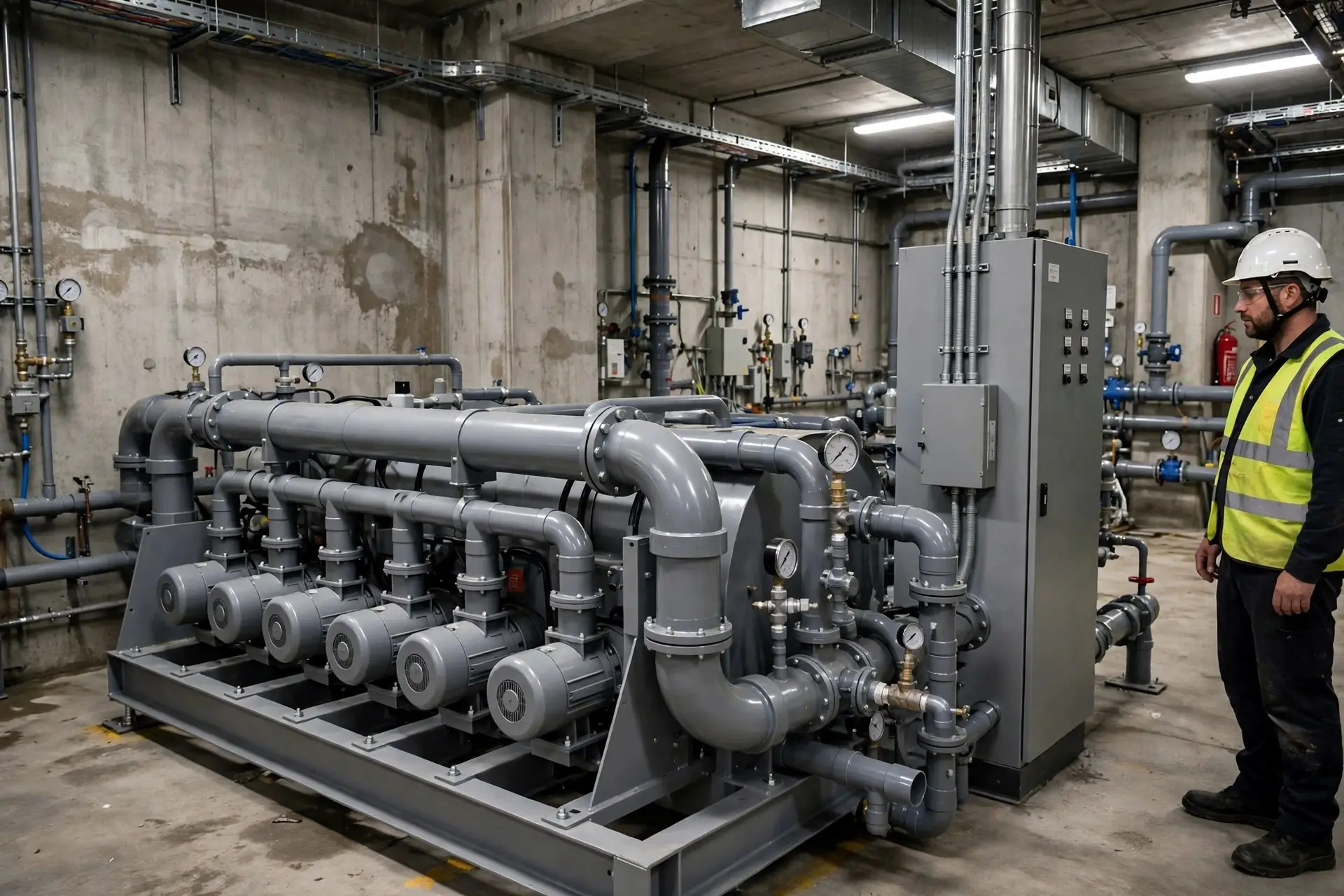
Realistic illustrative image: a blower and air distribution skid in an industrial plant room.
Counting the money properly
For the person approving the spend, the useful comparison is lifecycle cost over the same profile and period: capital, energy, maintenance, spares, downtime risk, and any building work. First cost alone will mislead, because the cheapest machine to buy is often the most expensive to run, and in an effluent plant the cost of a failed discharge can dwarf the blower price.
Energy can be estimated honestly from the plant's own numbers:
Annual energy cost = average power in kilowatts × hours per year × price per kilowatt hour.
Illustrative example only: a system drawing an average of 150 kilowatts, running 8,760 hours a year at 0.15 dollars per kilowatt hour, costs 197,100 dollars a year. A 20 percent saving is 39,420 dollars a year. A 30 percent saving is 59,130 dollars a year. Those figures are simple arithmetic, not a promise for any plant. A proper proposal should show its baseline, power at minimum, normal, and peak, hours at each point, and electricity price.
List other costs separately: diffuser cleaning frequency, replacement intervals in the actual effluent, standby provision, and production disruption during maintenance. A system needing frequent tank shutdowns for diffuser work may cost more than a slightly less efficient system maintainable in sections.
What to send for a sizing proposal
To size a system properly, TMC needs flow and organic load at normal and peak, discharge pressure or a complete pressure stack, tank dimensions and depth, diffuser type if installed, site elevation, ambient and effluent temperature range, operating profile across the day and production week, equalization volume, batch details, and any standby requirement, plus existing equipment and measured power where available.
TMC Fluid Systems supplies blower packages for effluent treatment, wastewater aeration, and industrial applications requiring large flow rates at moderate differential pressure. Each application is evaluated against airflow, pressure, elevation, temperature, turndown, and operating profile, including diffuser and piping losses, before a machine is proposed. Contact TMC Fluid Systems at (949) 269-1472 to discuss an application and request a proposal.
Frequently asked questions
Is diffused aeration the same as agitation?
No. Diffused aeration supplies air through diffusers, providing both oxygen and mixing. Agitation is the mixing job itself: keeping solids suspended, homogenizing the tank, and preventing dead zones. Specify both, because a tank can be mixed without enough oxygen, or aerated unevenly with dead zones.
Fine bubble or coarse bubble diffusers for industrial effluent?
It depends on the effluent. Fine bubble diffusers usually transfer oxygen more efficiently in clean water. Coarse bubble diffusers mix more vigorously and tolerate solids, grease, and fouling better, so in a greasy or high solids effluent they, or a mix of types, can be more reliable over the life of the plant.
What information is needed to size an effluent aeration system?
Flow and organic load at normal and peak, discharge pressure, tank dimensions and depth, temperature range, equalization volume, batch discharge details, and any standby requirement, plus diffuser type if already installed.
Should a plant choose a turbo blower or a positive displacement blower?
Turbo blowers are usually strongest at higher flows, moderate pressures, and variable demand. Positive displacement blowers remain right for many higher pressure, lower flow, or widely varying pressure duties. Compare measured power at minimum, normal, and peak, on fouled diffuser pressure as well as clean pressure.
What maintenance does a turbo blower need?
Essentially, replacement of the inlet suction filter. The shaft runs on air foil or magnetic levitation bearings with no contact, at the customer's preference, with no lubricating oil. Diffuser cleaning frequency should be set by the actual effluent.
Does a turbo blower need an acoustic enclosure?
Normally no. It runs at approximately 75 to 80 decibels at the machine, subject to the plant's own noise requirements.
Related pages
Turbo Blowers | Wastewater Aeration | Applications | Contact TMC Fluid Systems
